How to Find a Reliable Wireless Earbuds Supplier in China (And What I’ve Learned the Hard Way)
If you’ve been in the consumer electronics sourcing game for any length of time, you already know that finding a legitimate wireless earbuds supplier China isn’t as simple as typing a keyword into Alibaba and clicking “Contact Supplier.” I’ve spent years working directly with factories across the Pearl River Delta, and the gap between what looks good on a product listing and what actually shows up in your warehouse can be significant.
Let me walk you through what actually matters when you’re evaluating suppliers — not the stuff you read on generic sourcing blogs, but the things that separate a smooth production run from a nightmare.
The Market Landscape Has Shifted
Five years ago, most buyers shopping for a wireless earbuds supplier in China were primarily concerned with price and MOQ. Those are still factors, obviously. But the market has matured in ways that change the calculus considerably.
Chipset options alone have exploded. Where Qualcomm once dominated the premium TWS segment, you now have serious competition from Airoha (MediaTek), Bestechnic (BES), and Jieli platforms — each with different cost profiles, codec support, and firmware ecosystems. A supplier that’s deeply integrated with one chipset partner will have very different capabilities than one running a more generic platform. When I walk factory floors now, I ask directly which chipset platforms their engineers are certified to work with. The answer tells me a lot about their ceiling.
Shenzhen vs. Dongguan vs. Zhuhai — It’s Not All the Same
Most people think of “China manufacturing” as one monolithic thing. It isn’t. When you’re looking for a wireless earbuds supplier in China, geography within the Pearl River Delta actually matters.
Shenzhen remains the innovation hub. Factories here tend to have stronger R&D teams, faster prototyping cycles, and better access to component supply chains. You’ll pay a premium, but the engineering depth is usually there.
Dongguan is where a lot of the mid-volume, cost-competitive production happens. Strong on execution, sometimes weaker on customization depth. Good if your spec is already locked.
Zhuhai has been quietly building up a solid cluster of audio-focused manufacturers, particularly in the open-ear and bone conduction segment. Worth paying attention to if you’re moving into those categories.
The point is: don’t just evaluate a supplier in isolation. Understand where they sit geographically and how that affects their component access, labor costs, and supply chain resilience.
What I Actually Look for During Factory Audits
When I visit a potential wireless earbuds manufacturer, I’m not just checking whether the facility looks clean. I’m looking at operational specifics that indicate real production capability:
Driver assembly environment. Are they building in a controlled environment with appropriate humidity and dust controls? Acoustic components are sensitive. A factory that doesn’t take this seriously will have inconsistent unit-to-unit performance.
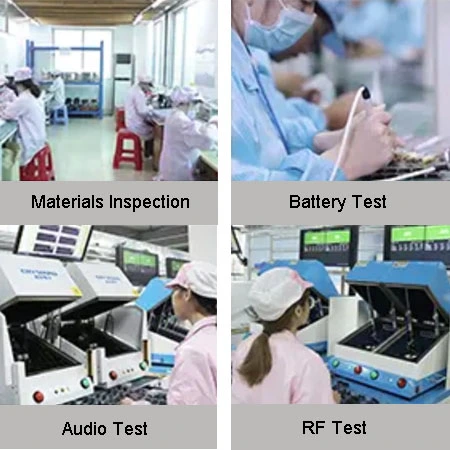
Anechoic or semi-anechoic testing setup. Any serious audio manufacturer should have in-house acoustic measurement capability — at minimum, a calibrated measurement mic and a quiet testing room. If they’re relying entirely on end-of-line functional pass/fail without frequency response validation, that’s a problem.
Firmware version control. This one trips up a lot of buyers. Ask the supplier how they manage firmware updates across production batches. Sloppy version control means you can get inconsistent feature behavior between early and late shipments of the same SKU.
ANC tuning documentation. If you’re sourcing active noise cancellation earbuds, ask to see their ANC algorithm tuning records. Any supplier worth working with should be able to show you target curves and how their production units perform against them.
OEM vs. ODM — Know What You’re Actually Buying
This distinction matters more than most buyers initially realize.
An OEM arrangement means you’re bringing your own design to the factory for manufacturing. You control the IP. The factory executes to your specification. This requires you to have an engineering team capable of writing a spec and managing the technical relationship.
An ODM arrangement means you’re licensing the factory’s existing design, typically with surface-level customization — your logo, your color options, your packaging, sometimes minor feature tweaks. The factory owns the underlying IP.
Most buyers in the $5–$25 retail price range are actually doing ODM, even if they call it OEM. There’s nothing wrong with that. But be honest with yourself about what you’re purchasing, because it affects your negotiating leverage, your IP position, and your long-term flexibility to switch suppliers.
Compliance Is Not Optional — And It’s Not the Supplier’s Problem If You Get It Wrong
I see this mistake constantly. A buyer sources a great-feeling wireless earbud from a Chinese supplier at a competitive price, ships it into the US or EU market, and then gets hit with compliance issues.
Here’s the reality: the legal responsibility for market compliance sits with the importer, not the factory. A reputable wireless earbuds supplier in China will offer FCC, CE, RoHS, and increasingly UKCA documentation — but you need to verify that those certifications are legitimate, current, and actually cover your specific product variant.
Some things to check:
- FCC ID verification — Cross-reference the FCC ID on the device against the FCC database. Fake or borrowed IDs are more common than you’d think.
- CE Declaration of Conformity — This should be a document you receive and review, not just a CE mark stamped on packaging.
- Battery compliance — UN38.3 certification for lithium batteries is required for air freight. If your supplier can’t produce this documentation quickly, that’s a red flag.
- RoHS material declarations — Particularly important if you’re selling into the EU.
Tashells Audio: A Supplier Worth Knowing in This Space
Among the manufacturers I’ve had direct experience with, Tashells Audio — based in Shenzhen — stands out for a few reasons that matter to serious buyers.
Their engineering team has hands-on experience across multiple chipset platforms, which gives them genuine flexibility when working with clients on custom SKUs rather than just pushing a house product. Their ANC lineup in particular has gone through serious tuning work — not just spec-sheet claims, but measurable performance you can verify with a measurement rig.
They’re also unusual in that they’ll actually walk you through their QC processes in detail — not just show you a clean factory floor for the camera. For buyers who care about what happens on the 10,000th unit rather than just the 10 samples you approved, that transparency matters.
If you’re actively evaluating a wireless earbuds supplier in China and want a benchmark for what a well-run mid-to-large-scale audio manufacturer looks like operationally, Tashells is worth including in your shortlist.
Final Thought
The wireless earbuds market is more competitive than it’s ever been, which means both the opportunity and the risk are higher. The suppliers who will matter in this space over the next five years are the ones investing in real engineering capability — firmware, acoustic tuning, compliance infrastructure — not just the ones with the lowest sample price.
Do your due diligence on the factory floor, not just the product listing. Ask uncomfortable questions. Request documentation you’ll actually verify. And build supplier relationships that can scale with you, not just fulfill your first order.